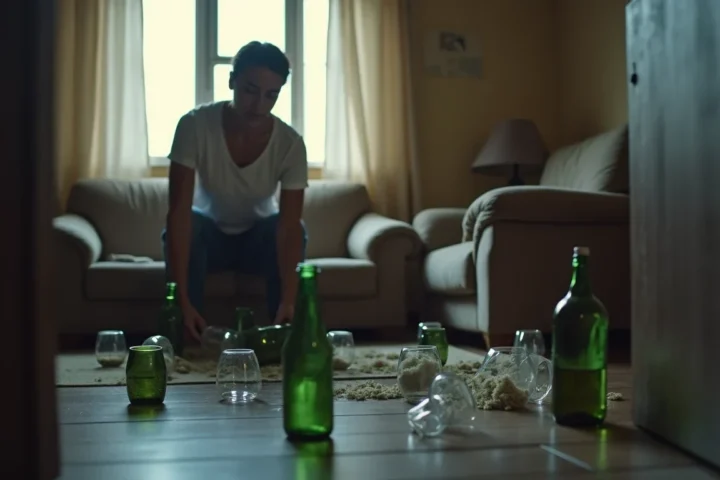

When drinking stops looking like a habit and starts running the household, the signs are usually plain: missed pieces of the night, arguments over how much was really taken, and the same promise to slow down that never holds.
The fight is rarely about one bad night. It is about the point where alcohol starts organising the day.
The line gets hidden in plain sight
Heavy social drinking and alcohol dependence can look similar from the outside for a long time. Both can include regular nights out, big weekends, and a culture of “just one more”. The difference is not a neat number. It shows up in control, consequences, and what happens when alcohol is removed.
A person can drink heavily without yet being dependent. They may go out often, drink more than they should, and still get through work, family life, and day-to-day obligations. Once dependence sets in, the pattern changes. Drinking starts to organise the day. Plans bend around alcohol. The first drink matters more than the setting. Some people begin drinking earlier. Some need more to get the same effect. Some wake with shaking, nausea, sweats, panic, or a pounding heart and reach for a drink before they can think clearly.
The official line is not clean because drinking rarely changes cleanly. It slides. A person tells themselves they are still the same because they still work, still pay rent, still laugh at braais, still arrive on time most of the time. Then they notice they are lying about the amount, counting bottles, hiding top-ups, or feeling irritated when other people do not drink as much as they do.
South African guidance commonly treats moderate drinking as no more than two standard drinks a day for men and one for women, with at least one alcohol-free day a week. Heavy drinking is often described as more than 14 standard drinks a week for men and more than 7 for women. Those numbers help, but they do not settle the question. Dependence is less about the weekly total than about loss of control, withdrawal, tolerance, and continuing despite harm.
The rationalisations sound reasonable until you line them up
People rarely say, “I think I am becoming dependent.” They say things that sound practical, even sensible.
“I only drink when I am stressed.”
“That was just a tough phase.”
“I am not hurting anyone.”
“I can stop whenever I want.”
“Everyone else drinks like this.”
“Alcohol helps me relax and be social.”
Each of those lines can hide a problem. Stress does not create dependence by itself, but using alcohol as the main answer to stress makes the bottle feel like a tool instead of a risk. A “phase” can last years. “I am not hurting anyone” usually means the harm has not yet become public enough to force a decision. “I can stop whenever I want” is often easiest to say just before a failed attempt to stop.
The mind does this for a reason. It does not like being caught in a contradiction. If someone believes they are responsible, capable, and in control, but their drinking is creating mess at home, at work, or in their body, the brain reaches for a defence. It minimises the harm. It compares the person to someone worse. It blames the week, the marriage, the boss, the traffic, the pressure, the loneliness, the fact that it was a special occasion, then another special occasion, then a rough patch that never really ends.
This is not moral failure. It is a familiar form of self-protection. It also keeps people stuck.
What dependence looks like when it stops pretending to be social
The sharpest warning sign is not how often someone drinks in public. It is what happens when nobody is watching.
A person may start organising evenings around alcohol, or feel uneasy when there is none available. They may drink earlier in the day than they used to. They may promise to have a few and then go far beyond that. They may black out and fill in the blanks later with guesses, excuses, or jokes. They may keep drinking after fights, warnings, accidents, missed appointments, or a doctor’s advice to stop.
Withdrawal is a harder line to ignore. Shaking hands, sweating, nausea, anxiety, poor sleep, agitation, or a racing pulse after a period without alcohol are not signs of a bad mood. They are signs the body has begun to adapt to alcohol’s presence. Casual drinking starts to look a lot less casual.
There is also the slow damage that people explain away because it arrives in pieces. A missed school pickup. A Sunday lost to a hangover. A client meeting missed. A short temper with children. Money vanishing into taxis, takeaway, extra rounds, or private promises to “sort it out next month”. Repeated apologies lose their force when the same scene keeps happening.
Alcohol dependence tends to leave fingerprints in several places at once:
- work performance drops or becomes unreliable
- family members start checking the person’s mood before speaking
- the drinker begins hiding bottles or refilling them
- mornings become harder to face without alcohol
- the person becomes defensive when asked simple questions about drinking
- attempts to cut back fail quickly or turn into bargain-making
One of the clearest signs is this: the drinking keeps going even after the person has already seen what it is costing.
The harm reaches further than the hangover
A heavy social drinker may pay for a bad night. A dependent drinker begins paying with larger pieces of life.
The physical damage is not theoretical. Long-term dependence raises the risk of liver disease, including hepatitis and cirrhosis. It can contribute to heart problems, pancreatitis, nerve damage, and some cancers. It also worsens sleep, which makes stress harder to manage and pushes the next drink closer.
Mental health often goes downhill with the drinking. Anxiety and low mood can come first, then get worse. Some people drink to quiet panic and end up feeding it. Memory becomes patchy. Concentration slips. Shame builds, then gets anaesthetised, then returns louder.
Relationships usually take the hit before the drinker admits anything is wrong. Partners get tired of broken promises. Children learn what kind of night to expect by the sound of a key in the door. Friends stop calling because every plan has become conditional on whether alcohol is involved. The drinker notices distance, feels rejected, and often drinks to blunt that feeling too.
The financial strain can be just as plain. Extra spending becomes normal. Work slips. Warnings stack up. In severe cases there are legal consequences, including drunk driving charges and other alcohol-related offences. The bill for dependence is rarely one bill. It is a trail of smaller losses that finally add up to something too large to explain away.
Treatment, without the fantasy
The country does have a legal framework for substance abuse prevention and treatment. The Prevention and Treatment for Substance Abuse Act, Act 70 of 2008, exists to recognise that harmful use needs a response that goes beyond family pleading and self-blame.
That response usually starts with assessment. A doctor, addiction counsellor, or treatment centre will want to know how much is being used, how often, what happens on days without alcohol, whether there have been seizures or severe withdrawal, and whether there are other mental health or medical issues in the picture. Alcohol withdrawal can become dangerous, and the first question is often whether detox needs medical supervision.
For some people, outpatient support is enough. For others, residential treatment is safer, especially when withdrawal is severe, relapse risk is high, or the home environment keeps pulling the person back into the same pattern. After detox, the harder work starts. Therapy, relapse prevention, family involvement, and aftercare matter because stopping drinking is one problem and staying stopped is another.
Cost shapes access in a blunt way. Private rehab can run into many thousands of rand, and some facilities charge by the week or month. Medical aid may cover part of an admission, but benefits are limited and depend on the plan. Provincial services exist, but the gap between need and access can be wide. Waiting lists, transport, and family pressure all become part of the decision. Many families are dealing with this reality, not an abstract system on paper.
Questions that cut through the excuses
A drinking diary is less glamorous than a resolution, and far more useful. Write down when you drink, how much, who you were with, what was happening, and what followed. Do that for a few weeks. The pattern usually becomes uncomfortable fast.
Ask a few blunt questions:
- Do I drink more than I planned, more often than I admit?
- Do I feel rattled, shaky, or ill when I do not drink?
- Have I promised to cut back and failed?
- Have I hidden drinking, lied about it, or edited the story later?
- Is alcohol helping me cope, or is it shrinking my life?
Ask someone who sees you often and will not flatter you. Then listen without defending every line. A partner, sibling, colleague, or friend may have noticed changes you have spent months explaining away.
If the answer is still unclear, get a professional assessment. A doctor or addiction specialist can separate a heavy pattern from dependence, and can also check whether withdrawal would need medical oversight. This is not a dramatic step; it is a sensible one.
When to stop treating it as a private problem
Some signs need urgent attention, not another promise on a Monday morning.
> Seek immediate medical help if there is confusion, seizures, repeated vomiting, hallucinations, chest pain, fainting, or severe shaking after stopping alcohol.
Those symptoms can mean withdrawal is becoming dangerous. If someone has gone from daily drinking to stopping suddenly and then becomes unwell, the risk is not just discomfort. It can turn serious quickly.
Families often wait for a catastrophe because they want certainty. By the time the certainty arrives, the person has usually lost more ground. The better question is not whether the drinking has become disastrous enough. It is whether the current pattern is already larger than the person can manage alone.
What honest next steps look like
Start with the facts, not the story you have been telling yourself. Count the drinks. Count the blackouts. Count the failed attempts to cut back. Count the mornings you swore it was the last time.
Then do something that interrupts the pattern. Book an assessment. Speak to SANCA for guidance. Ask a doctor about withdrawal risk before trying to stop alone if the drinking has been daily or heavy. If the home situation is chaotic, ask about residential care. If money is the barrier, ask what medical aid will cover and what provincial services are available. If shame is the barrier, remember that shame is part of the trap, not proof that you should stay in it.
The line between social drinking and dependence is often crossed long before anyone wants to admit it. The first lie is usually small. The damage is rarely small for long.